
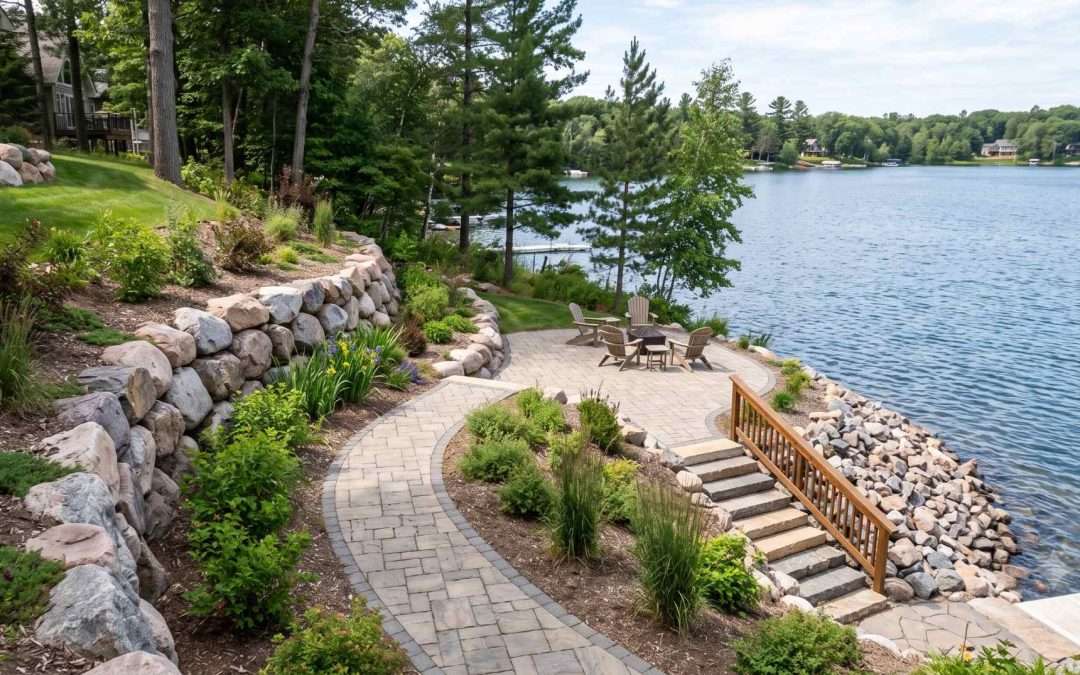
Managing a sloped lot on the Alexandria Chain of Lakes requires a careful balance between outdoor living design and structural engineering. Properties on bodies of water like Lake Carlos, Lake Darling, or Lake Le Homme Dieu often face issues with soil erosion and runoff caused by steep inclines. Using hardscaping elements like retaining walls, stone pavers, and rip-rap can stabilize your shoreline while creating functional outdoor spaces that enhance the property.
Lakeshore hardscaping is strictly regulated in Douglas County to prevent soil from washing into the water and damaging the lake habitat. Every structural change near the shoreline must focus on stability, water drainage, and compliance with local environmental rules.
Shoreline Stabilization Methods
| Stabilization Option | Main Components | Primary Purpose |
| Retaining Walls | Engineered block or natural boulder systems. | Holds back soil on steep hillsides to create flat terraces. |
| Rip-Rap | Coarse, fractured rock over geotextile fabric. | Protects the immediate shoreline from wave action and ice heaving. |
| Permeable Patios | Interlocking concrete pavers with wide aggregate joints. | Provides a flat seating area that lets rainwater soak into the ground. |
| Natural Buffers | Deep-rooted native shoreland plants and grasses. | Binds the soil together organically to prevent surface erosion. |
Permits and Retaining Walls Near the Water
Douglas County Land and Resource Management requires a permit for almost all structural earth-moving within the shoreland district, which extends 1,000 feet from the lake. Building a retaining wall within the 75-foot structure setback—and especially within the 37.5-foot Shore Impact Zone—is heavily restricted.
New retaining walls are generally not permitted near the water unless they are deemed absolutely necessary to correct an active, severe erosion problem that cannot be fixed with vegetation alone. If you are replacing an existing, failing retaining wall, you will need a Shoreland Alteration Permit, and the county may limit the height and material options to minimize the visual impact from the water.
Preventing Patio Shifting from Freeze-Thaw Cycles
Minnesota winters cause significant ground movement due to frost heaving. When water in the soil freezes, it expands and pushes upward, which causes standard patios to crack and shift unevenly. Building a durable lakeside patio requires a deep, well-draining foundation base.
The process begins by excavating the soil down 8 to 12 inches. We install a woven geotextile fabric to separate the natural dirt from the new base material, then add a 6-inch layer of crushed angular limestone, compacting it firmly. Instead of standard sand, a layer of clean, open-graded aggregate is laid down, followed by the pavers. Joint sand that allows water to pass through freely prevents moisture from trapping beneath the surface, ensuring the patio drains quickly and settles back evenly after the spring thaw.
Frequently Asked Questions
Do I need a permit for a retaining wall if it is within 50 feet of the lake edge?
Yes. Any retaining wall built within 75 feet of the ordinary high water level requires a permit from Douglas County Land and Resource Management. If the wall is within 50 feet, it sits inside the sensitive Shore Impact Zone where new structures are highly restricted. You must prove the wall is strictly for erosion control, not just for landscaping aesthetics.
What are the best native plants for preventing shoreline erosion in Alexandria?
Deep-rooted native plants are excellent for locking down lakebanks. For wet shoreline edges, Blue Flag Iris and Swamp Milkweed work well. For the sloped bank above the water line, Red-Osier Dogwood, Little Bluestem, and Black-Eyed Susan provide deep root systems that hold the soil structure together much better than standard lawn grass.
How do I build a patio that won’t shift during the Minnesota freeze-thaw cycle?
The key is installing a thick, compacted base of crushed angular stone over a geotextile fabric filter. The entire system must drain water away quickly so moisture cannot pool under the pavers and freeze. Using open-graded aggregate instead of traditional fine sand ensures the patio remains flexible and stable during winter temperature swings.
What is rip-rap and when is it legally required for lakefront stabilization?
Rip-rap is a layer of large, angular stones placed along the shoreline to protect the bank from wave erosion and ice damage. It is not legally required for every home, but it is permitted when natural vegetation cannot stop active shoreline erosion. Douglas County and the MN DNR regulate the size of the rock used and the distance it can extend up the bank.
How much does a stone staircase to the lake cost in the Alexandria Chain area?
A natural stone or engineered block staircase built on a steep lake slope typically costs between $15,000 and $35,000, depending on the length of the hill, access challenges for heavy equipment, and the number of required structural landings. The county limits residential staircases to a maximum width of 4 feet to protect the hillside.
Can I clear trees on my sloped lot to make room for a patio layout?
Intensive clearing of trees and shrubs is prohibited within the Shore Impact Zone and on steep bluffs. You are permitted to clear a limited path and viewing corridor, but the county requires you to maintain a high percentage of the natural canopy to prevent slope failure and keep the home screened from the lake view.
Stabilizing a lakeside slope requires a practical understanding of both soil physics and local zoning laws. Wensmann Contractors specializes in the site engineering needed to build functional, long-lasting structural walls, patios, and staircases on difficult lake lots. We handle the county permitting and structural groundwork so your outdoor living space remains safe and stable for decades of lake life.
By: Wensmann Contractors Team Last Updated: July 15, 2026
Greg Wensmann, 2021 CMBA Builder of the Year, leads our design-build team in providing structural hardscaping, custom home construction, and shoreline renovations across Central Minnesota.